
|
|
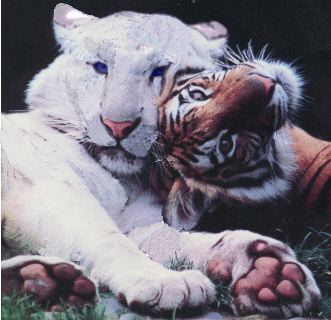
"Let no man or god come between a woman and her cat"
The Passing from Infancy into Childhood
When a girl reaches the age of thirteen years (about
six years t'nizt), she is acknoledged in society as begining her spiritual
quest. This is a quest that we all must embarc on, be we T'nizt woman,
or Human mystic. It is the quest to find out who we are...and who we were.
It is also the quest to begin to hone the psychic abilities we are born
with.
The ritual is called "The Passing" I will spare
you the many syllabled and difficult to pronounce T'nizt word for it. It
marks the passing from infancy into childhood. This is the time when we
each must learn how to become independant, both spiritualy, and materialy.
I should explain, here, to prevent further confusion, that the T'nizt enjoy
a particularly long childhood. As a long lived species, it takes a total
of 60-80 years for us to reach maturity, physically speaking, and another
fourty to be accepted in society as a full fledged adult. In that time,
alot can happen, your parents may die, you siblings may go off on long
vision quests, you may move to new locations, and through it all, a girl
constant companion is her cat.
In The Passing, a girl goes into meditation, fasting
for three days, to determine her totem, her particular psychic talents,
and her calling in life. At the end of it, one of the cats will choose
her. Usually, it is the cat who posesses your weakest senses that will
choose you, as encouragement to persue those talents you lack. This cat,
usually the size of a Siberian Tiger, with the tempermant and loyalty of
a puppy, coupled with a sparkling, sentient intelligence serves another
vital purpose: Protection. The following narative from The Raeschoa (roughly:
Princess) illustrates how choosing a companion feline is often an imperfect
prosess:
"In the monastary, my twin and I were left alone with the cats. Briefly, a small, snow white elder-cub gazed into my eyes, and quite impetuously, my sister squealed at her beauty, and scooped the animal up in her arms. She set her down, and the cat stayed with her. And as I sat, gazing jealously at the cub,one came to me, black as onyx. His thoughts were rather incomprehensible... fleeting ideas, and images. This was my cat. I named him Olam (Word for Night-sky: Night Ether), and My sister's was Mitzka (Little Dog: Puppy). My sister, though she was the Becshoa (Dutchess, fated to become prime minister), showed more interest in bussiness than her spirit. Her cat went unfed, and largely ignored. Mitzka's thoughts were allways clear to me, even at a distance, and we develped a special bond that I quite lacked with Olam. I fed her,and spent long hours talking to her...and when I finally left home,both cats came with me."

Even though the T'nizt are polyandrous (women have large harems consisting
of antwhere from 3 to 100 men, the later figure comming from the queen's
harem, the former indicating the bare minimum), the concept of love and
soulmates is not a foreign one. A woman's first husband is sacred to her,
generally pampered, and is the only one allowed to sleep in the house with
her. He also bares partial responsibility in raising female children, which
other harem members are denied.
The mariage cerimony is typicaly T'nizt: Straightforward, understated,
and very honest. The man and woman publicly proclaim their love for one
another, and drink from a wooden goblet filled with either juice or water
brewed with special flower petals to symbolize their union, while kneeling
in the center of the life-circle, inscribed on the floor of the monastary.
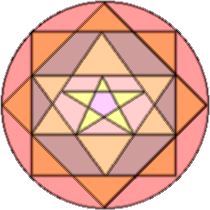
At the Circle's Center
This Figure is Asumed to Represent the Union of Earth's
Religions
In T'nizt Mythology, it is both the petals of the Timra
(sacred flower)
and the entrance to the womb of the Goddess: Thus representing
the union between mortal and divinine
Although this husband is refered to as the "first" he may not be the actual first member of the harem aquired. Not all women may go through this cerimony. Generally, if a first husband is not found before a woman turns ninty, she begins to aquire husbands through purchase, trade, and as gifts from friends (who do not want to keep their brothers in their harem). If she is the eldest child, she may also inherit a harem from her mother (see turn of life)
Curiosly, there is little social stigma attatched to one's having a
small harem. A much greater determining factor in a woman's status is the
number of female children she has, and her overall wealth (her harem is
included in the latter catergory)

In T'nizt beliefs, a person may die many times in the course of a lifetime.
Death is a passage or a change, and little else.
However, in every culture, there is that rather unpleasant issue to
be dealt with: What to do with the remains. The ritual farewell to the
deceased usually occurs after the body has been disposed of. Usually, this
is a simple statement, spoken outloud, before friends and family.
The ritual disposal of the body, however, differs from province to province.
In Hyspa, the body is thrown into a burning heap of wood, In Scelts, the
ritual is far less flashy, but the body is still cremated. The Keridian
prefer to bury their dead,
or toss them into the mouth of the local active volcano. Isolian are
partial to a burial at sea, where they believe the body is recycled when
it is eaten by fish, in this way, they reciprocate the favor the Goddess
granted by providing them with the body in the first place. Outlanders
frequently deposit the body in the woods, allowing the denizens of the
forest to eat the remains, much for the same reasons.
Generaly, the Harem of a deceased woman is divided amongst her sisters and daughters. If she has no living relatives, then the men in her harem either go to her closest friend, or become property of the state, and are added to the Queen or Govener's harem. Young children left behind after the death of their mother are either raised in the monastary, or by older sisters, the latter of the two being much more common.